
Mining
Operator alertness on opencast HEMM — perception that knows the limits of its own competence, and says so. Carried on MIP-1 and MSP-1, open India-first protocols for mine-vehicle safety data.
DFMS — Driver Fatigue Monitoring System ↗The Problem
A warning system crews have learned to ignore protects no one.
Detecting a closed eye is a solved problem in the laboratory. In an opencast cab — low sun, dust, night operation, IR reflection, eyewear, reversing and tipping, vibration — it is not. A system that answers every such frame with confidence produces nuisance alarms, and nuisance alarms are what take its authority away in the cab.
Always-answer
Every frame gets a verdict, whatever the light, dust, eyewear or head pose. Ambiguous frames become confident alarms. Operators stop responding, and the monitor is still installed but no longer protecting anyone.
Self-aware
The system characterises where it is competent — in physical terms a mine can check — recognises when an observation falls outside that envelope, and abstains rather than asserts. The qualification discipline of physics-grounded AI, carried into the cab.
The Next Generation
From always-answer to self-aware perception
Output
A binary alarm on every frame
Alert, no alert or abstain — each with its reason
Competence
Implicit; quoted as one laboratory accuracy figure
An explicit envelope in physical terms: light, occlusion, pose, vibration, heat
Uncertainty
Not exposed
Calibrated, with a stated coverage guarantee
Outside competence
A confident guess, heard in the cab as a nuisance alarm
Recognised, withheld and logged
Failure
Silent — crews learn to ignore the system
Sustained abstention escalates to the control room as “monitoring degraded”
Evidence
An alarm snapshot
An auditable record: decision, confidence, position in the envelope, frames
Alert
Inside the validated envelope and the state is unsafe. Cab alarm and control-room event, with evidence frames.
No alert
Inside the validated envelope and the operator is alert. Nothing to interrupt the shift.
Abstain
Outside the envelope — glare, dust, eyewear, an unusual pose. No guess is made; the reason and frames are logged, and sustained abstention escalates.
Abstention withholds a nuisance alarm. It never hides a degraded monitor.
India-First Protocols
India has no common language for mine-vehicle safety data.
The nearest Indian standard, AIS-140, addresses tracking and emergency alerting for public-service vehicles. It was not written for mining equipment and does not define safety-alarm meaning, confidence or evidence. So every terminal on HEMM speaks its maker’s own protocol — and the consequences fall on the mine and the regulator.
A foreign protocol by default
Imported terminals bring their own protocols. Without an Indian standard, whichever ships in the greatest volume becomes India’s standard — chosen and maintained elsewhere.
Vendor lock-in
Terminal, cloud and control room come as one package; changing supplier means replacing hardware on every machine.
Fragmented control rooms
Departmental and contractor HEMM from several makers, watched on several dashboards, with no single view of safety events.
Alarms that cannot be compared
Each maker defines fatigue and severity differently, so performance cannot be specified or evaluated across fleets.
Evidence that does not hold
No common rules for time, attachments or tamper-evidence — records are hard to rely on in an inquiry.
Safety data leaving by default
Operator video and mine operating data routed to servers the mine did not choose, often outside India.
MIP-1
First-generation Mobility Intelligence Protocol
Registration, heartbeat, position, safety events, and two-way command and control between the cab and the control room.
MSP-1
Media Streaming Protocol
Live video, playback and evidence clips — the record behind every alert and every abstention.
- Typed safety events with a published taxonomy — a fatigue alarm means the same thing from every terminal.
- Confidence and abstention as protocol fields — every event says how sure it is, and a system can declare it cannot judge.
- Evidence integrity — synchronised time, hashed attachments, an auditable chain from cab to control room.
- Data residency by design — encrypted transport, authenticated devices, endpoints the mine chooses, in India.
- Open and versioned — a published specification any Indian maker can implement and any control room can receive.
MIP / MSP Mobility Intelligence Architecture
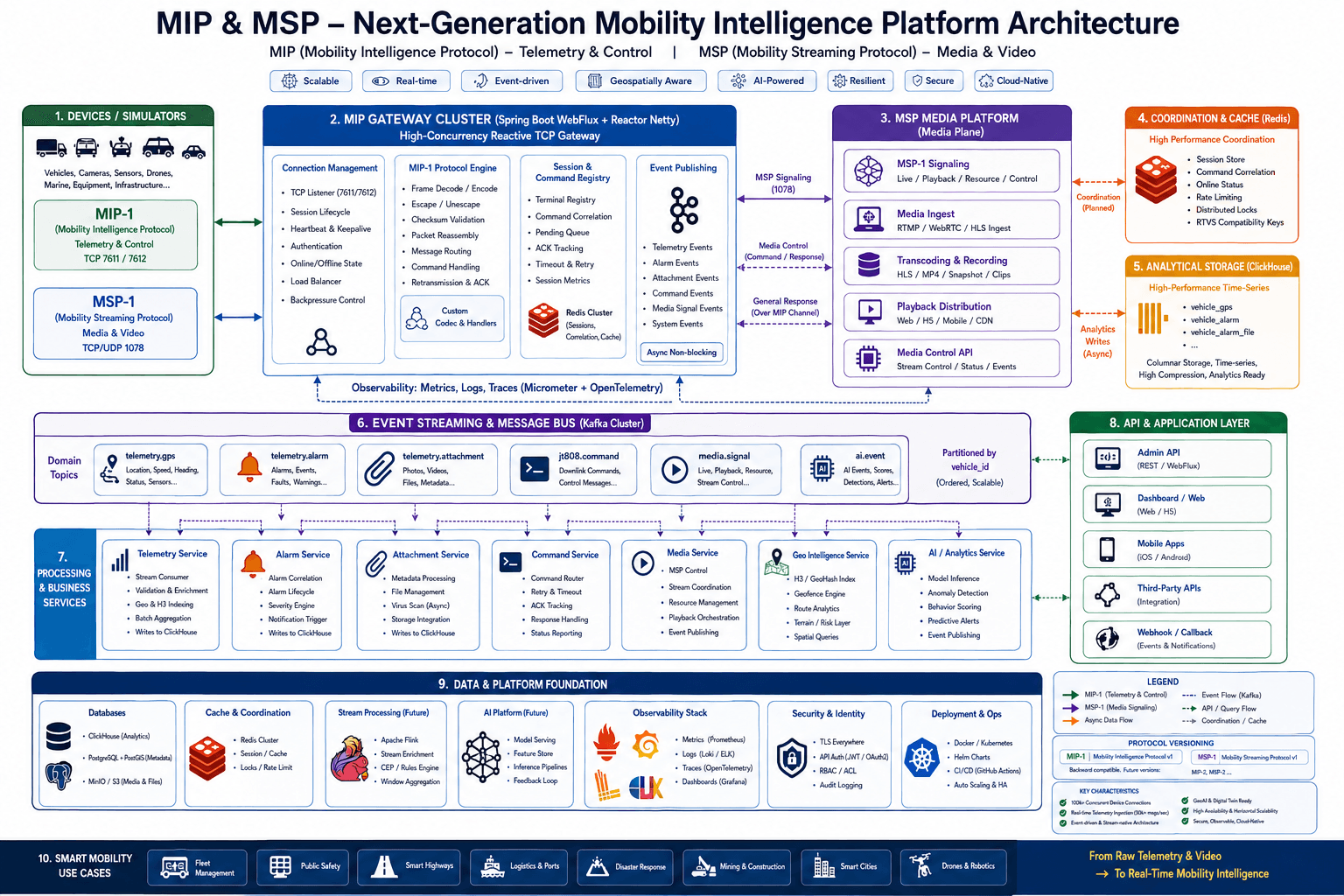
Where It Stands
Honest, per capability
What is built is built. What is research is research. The mining programme exists to move the second list into the first, in a working opencast mine, with independent measurement.
In-cab NIR sensing and detection
BuiltMIP-1 / MSP-1 platform protocols
Platform running · open specification in draftingEnvelope characterisation for opencast cabs
ResearchAbstention-based alerting in the field
ResearchIndian reference dataset and evaluation protocol
ProposedThe same operator-attention reasoning runs on the crane in steel — DFMS crane mode.