Multi-HazardReal-TimeExplainable AIPhysics-CertifiedZero Moraine HardwareGIS NativeSovereign ReadyMission Mausam Compatible

goatai.io/glof

Glacial Hazard Intelligence

Neuro-Physics Multi-Hazard Cascade Intelligence Platform. Early Warning. Causal Understanding. Real-Time Action.

High-Risk Lakes Monitored

195

Himalayan scope

Inundation Map Generation

<60s

Decision ready

Faster than Classical

100×

vs HEC-RAS 2D

Warning Lead Time

Days

vs hours (current)

The Himalayan Hazard

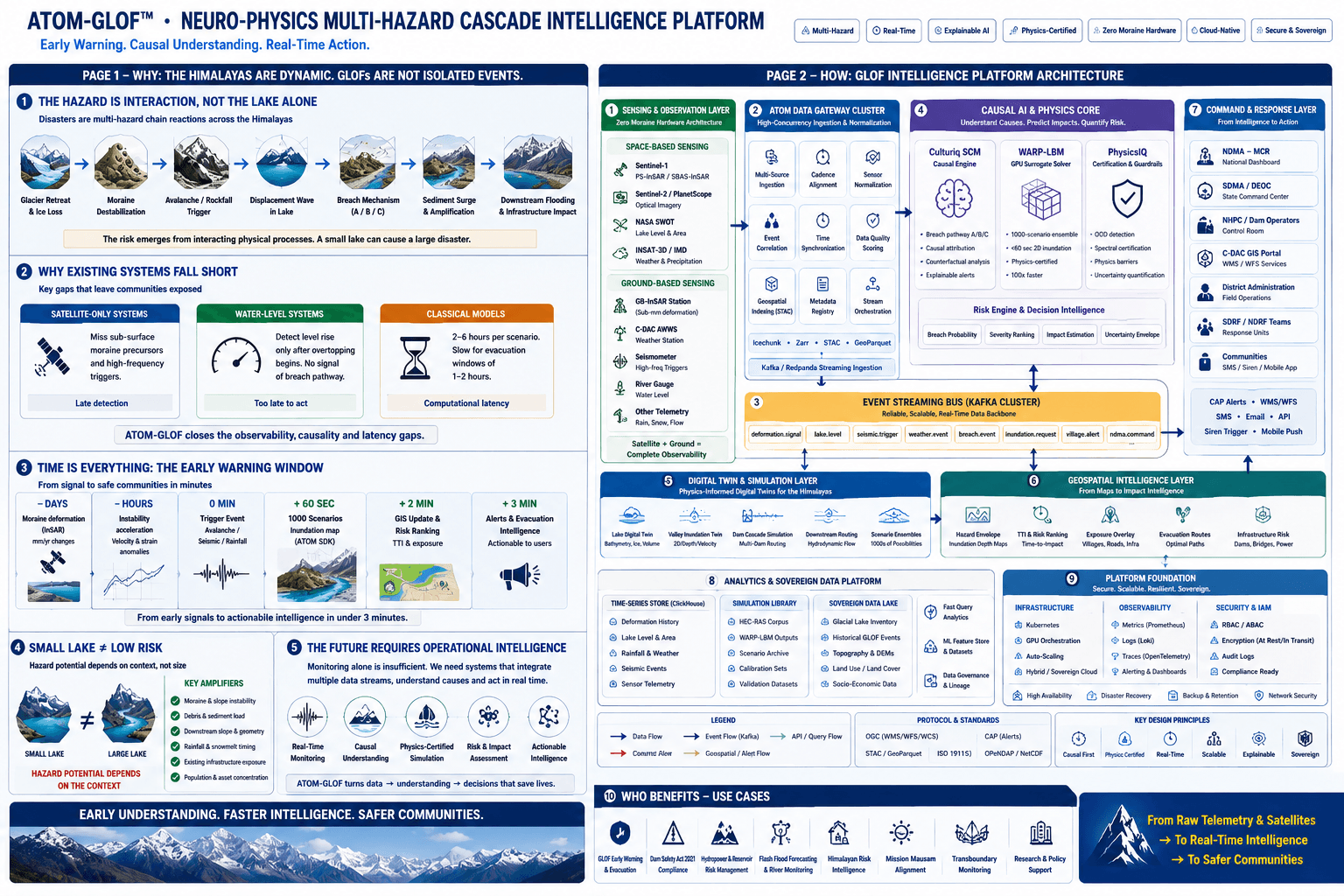
The hazard is the interaction, not the lake alone

Disasters are multi-hazard chain reactions. A small lake in a destabilized moraine can be more dangerous than a larger lake in stable terrain. The risk emerges from interacting physical processes across space and time.

01

Glacier Retreat & Ice Loss

Thermal forcing accelerates ice mass loss

02

Moraine Instability

Dam weakening from melt-water saturation

03

Avalanche / Rockfall

Slope failures from destabilized terrain

04

Displacement Wave

Mass entering lake generates surge

05

Breach Mechanism (A/B/C)

Overtopping, piping, or structural failure

06

Sediment Surge

Amplified debris load in flood wave

07

Flood Wave

High-velocity downstream inundation

08

Downstream Impacts

Communities, dams, infrastructure

Small Lake ≠ Low Risk

Hazard potential depends on context: moraine instability + slope geometry + infrastructure exposure = true risk level. The hazard is the interaction.

Critical Gaps

Why existing approaches fall short

Three dominant approaches, three critical gaps. ATOM-GLOF closes the observability, causality, and latency gaps simultaneously.

Satellite-Only Systems

  • Miss sub-surface moraine instability
  • Detect water level rise only after overtopping begins
  • Late detection → limited decision window

Water-Level Systems

  • No visibility of moraine deformation or displacement
  • 2–6 hour evacuation response window
  • Too late to act on early signals

Classical Numerical Models

  • 2–6 hours per simulation scenario
  • Computational latency delays decisions by hours
  • Early warning window lost before simulation completes

ATOM-GLOF closes the observability, causality & latency gaps simultaneously.

The Early Warning Window

Time is everything: days, not hours

Current systems give you 1–2 hours from water level rise to evacuation. ATOM-GLOF gives you days from moraine deformation to safe communities. That difference is the difference between reactive response and proactive resilience.

Days

Moraine deformation

Accelerating instability — GB-InSAR + PS-InSAR

Hours

Velocity / strain changes

Earthquake · intense rainfall · threshold approach

Minutes

Trigger event

Water level rise · displacement surge detected

0 min

1000 scenarios run

GIS inundation map generated by WARP-LBM

+60 sec

Confidence scoring

Risk ranking · time-to-impact per village

+2 min

Automatic SMS alerts

State agencies and district administrations notified

+3 min

Operational intelligence

Actionable to emergency operations centers

Early Understanding. Faster Intelligence. Safer Communities.

From raw telemetry and satellite data → to real-time intelligence → to life-saving action.

Nine-Layer Agentic Architecture

From raw telemetry to real-time operational decisions

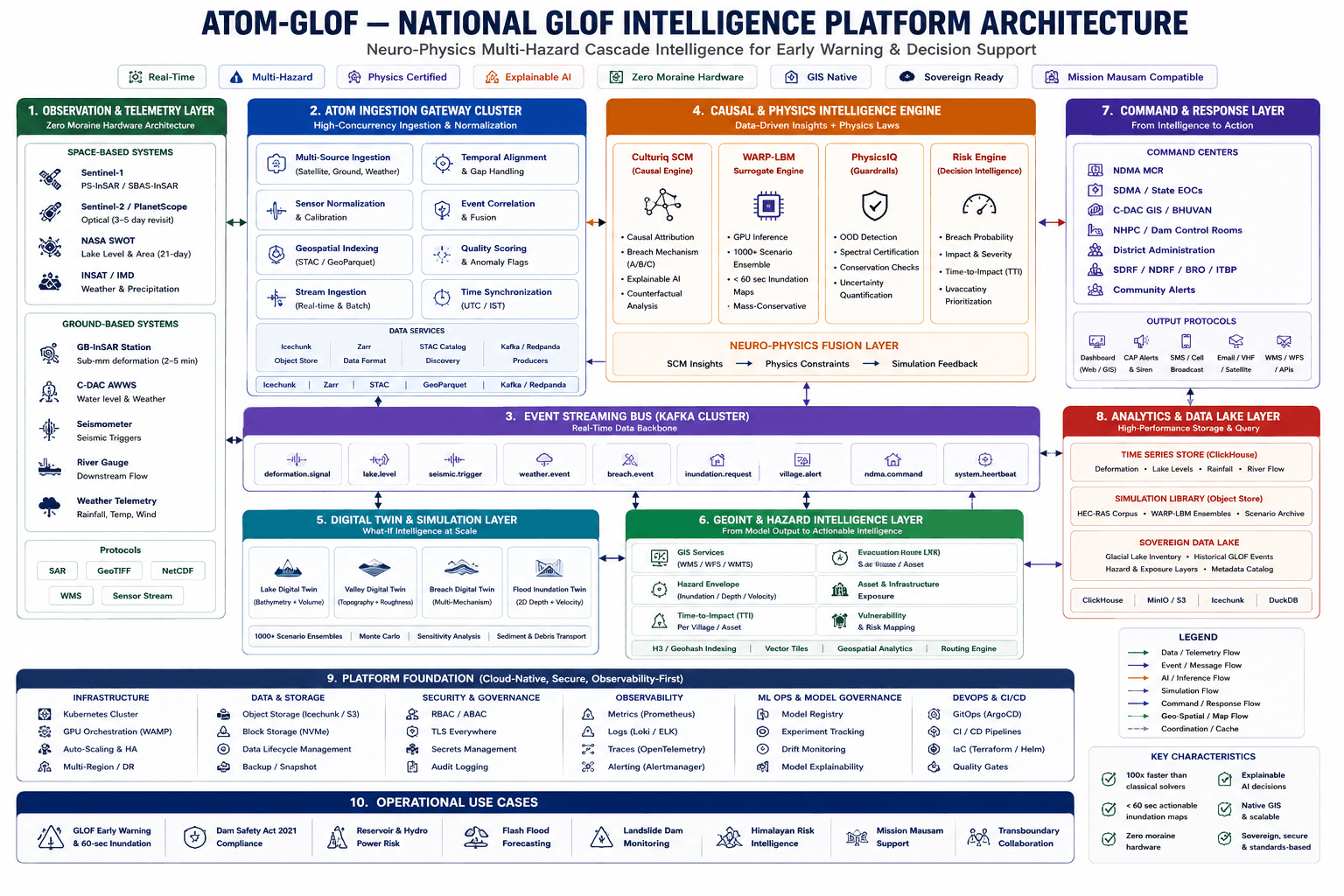
Four agentic agents orchestrate across nine architectural layers — from satellite observation to evacuation coordination. The same SENSE → UNDERSTAND → DECIDE → ACT cycle as every GoatAI platform, grounded in glacial physics.

ATOM-GLOF · National GLOF Intelligence Platform · Nine-Layer Architecture

ATOM-GLOF Nine-Layer Agentic Architecture — from observation to command response

01 — Monitoring Agent

Sense

Layers 1–3: Observation · Ingestion · Event Streaming

  • Sentinel-1/2 SAR · PS-InSAR · SBAS-InSAR — space-based deformation
  • NASA SWOT — lake level & area (21-day revisit, R²=0.99)
  • GB-InSAR — ground-based, sub-mm accuracy, 2–5 min refresh
  • Seismometer · River gauge · Weather telemetry · C-DAC AWWS
  • Kafka event bus — all signals fused and temporally aligned in real-time

02 — Prediction Agent

Predict

Layers 4–6: Causal Engine · Digital Twin · GeoINT

  • Culturiq SCM — causal breach mechanism attribution (A/B/C pathways)
  • WARP-LBM — GPU surrogate, 1000+ scenarios, <60s inundation maps
  • PhysicsIQ — out-of-distribution detection, conservation checks
  • Digital twin — lake, valley, breach mechanism, flood inundation
  • GeoINT layer — TTI per village, hazard exposure, vulnerability mapping

03 — Reasoning Agent

Reason

Embedded in Layers 4–6

  • Which system is in high-sensitivity regime? (moraine, valley saturation)
  • What threshold breaks the cascade? What terrain absorbs shock?
  • How do small changes amplify non-linearly?
  • Confidence envelope + causal attribution per breach pathway
  • Explainable AI — why this pathway, not just what outcome

04 — Decision Agent

Decide

Layers 7–9: Command · Data Lake · Platform Foundation

  • State-based adaptation — not threshold alerts ('system in high-sensitivity')
  • Per-village time-to-impact accounting for cascade amplification
  • Real-time route optimization as secondary failures occur
  • NDMA / SDMA / District Admin — tiered alert dispatch
  • Kubernetes + GPU orchestration, Prometheus observability, SOC 2-ready

WARP-LBM Surrogate

100–270× faster than HEC-RAS 2D

GPU-accelerated shallow water equations. Mass-conservative and stable. 1000+ scenario ensembles generated in under 60 seconds.

Culturiq SCM

Causal Discovery Engine

Breach mechanism attribution across A/B/C pathways. Explainable AI — causal reasoning, not correlation. Tells you why this pathway, not just what will happen.

PhysicsIQ

Physics Certification Layer

Out-of-distribution detection. Spectral certification. Conservation checks: mass, momentum, energy. Every output is physics-validated before dispatch.

Layer 7 — Command & Response

Government-scale deployment ready

Six output channels. Seven command center integrations. Standard GIS formats ensure plug-and-play compatibility with existing national infrastructure — no custom connectors required.

Output Protocols

Dashboard (Web/GIS)

Real-time operational view for command centers and district administrations

CAP Alerts (Siren/Broadcast)

Common Alerting Protocol — national emergency broadcast infrastructure

SMS / Email

Immediate notification to state agencies, districts, and communities

Kafka / Rejnala (Streaming)

Real-time data feeds for downstream system integration

WMS / WFS / WMTS (Geospatial)

Standard GIS format — plug into BHUVAN, C-DAC GIS, ArcGIS, QGIS

Mobile Apps (iOS/Android)

Community-level alerts with per-village time-to-impact

Command Centers Integrated

NDMA MCR — Multiscale Control Room (national)

SDMA / State Emergency Operations Centers

C-DAC GIS / BHUVAN (national GIS platform)

NHPC / Dam Control Rooms (reservoir safety)

District Administration (evacuation decisions)

SDRF / NDRF / ITBP (field response forces)

Community alerts — CAP, SMS, mobile push

Deploy Glacial Hazard Intelligence

Three integration pathways

Each stakeholder group has a distinct operational need and integration model. Choose your pathway.

Government Agencies

NDMA, SDMA, State Administrations

Early warning needed for evacuation planning and coordination decisions.

  • Standard GIS format (WMS/WFS/WMTS)
  • Real-time alert API (Kafka topics)
  • Per-region time-to-impact estimates
  • 1000+ scenario ensemble outputs
Request Integration Assessment

Dam Operators

NHPC, NTPC, Hydropower Companies

GLOF risk to upstream dams and reservoirs requires continuous upstream monitoring.

  • Private lake monitoring capability
  • SCADA integration (operational)
  • Automated reservoir level management
  • Early risk alerts for operations
Request Operational Pilot

Research & Policy

Universities, Institutes, Policy Bodies

Need validated physics-grounded frameworks for glacial hazard research.

  • 195-lake validation dataset
  • PhysicsIQ certification methodology
  • Collaborative research partnerships
  • Publication & knowledge advancement
Explore Research Partnership

Proven at Scale

What makes ATOM-GLOF different

Validated at operational scale. 195 high-risk Himalayan glacial lakes. Government-scale deployment ready. Physics-certified at every layer.

100× faster

Than classical solvers — 100–270× vs HEC-RAS 2D at equivalent accuracy

<60 seconds

Full 2D inundation map from trigger event, 1000+ scenario ensemble

Zero moraine hardware

Satellite + base camp only — no sensors in or on the moraine dam

Explainable AI

Physics-certified causal attribution — why this pathway, not black-box probability

GIS Native

Standard WMS/WFS/WMTS — integrates directly with BHUVAN, ArcGIS, QGIS

Sovereign Ready

Indian tech stack · Mission Mausam compatible · Dam Safety Act 2021 aligned

Validation Evidence

SBAS-InSAR: Detected deformation precursor 120 days before 2020 Jinwuco GLOF
PS-InSAR: Imja Lake ice dynamics validated (University of Washington, 2024)
SWOT satellite: 2,924 Himalayan lakes, R²=0.99 lake level accuracy (Han et al., 2026)
PhysicsIQ: All physics barriers passed — mass conservation, momentum, energy
Performance benchmark: 100–270× faster than HEC-RAS 2D at equivalent accuracy

Real-world reference: 2023 Sikkim GLOF — ₹4,500+ crore damages, 40+ fatalities. ATOM-GLOF would have detected deformation days before water level rise.

Operational Use Cases

10 real-world scenarios

Who benefits from glacial hazard intelligence — from national disaster management to village-level preparedness.

01

GLOF Early Warning & 60s Inundation

Continuous monitoring, trigger detection, sub-minute inundation maps for evacuation decisions.

02

Dam Safety Act 2021 Compliance

Physics-grounded risk assessments aligned with India's Dam Safety Act 2021 monitoring obligations.

03

Reservoir & Hydropower Risk Management

Upstream lake monitoring integrated with SCADA for automated reservoir level response.

04

Flash Flood Forecasting

Multi-hazard cascade modeling extending beyond GLOF to debris flows and secondary floods.

05

Landslide Dam Monitoring

Secondary failure detection — identifies temporary dams formed by landslides mid-event.

06

Himalayan Risk Intelligence

195-lake continuous monitoring providing national-scale hazard situational awareness.

07

Mission Mausam Alignment

Compatible with India's national weather and disaster preparedness modernization program.

08

Transboundary Coordination

India–Nepal–Bhutan shared river basin coordination for cross-border GLOF response.

09

Research & Policy Support

Validated datasets, PhysicsIQ certification methodology, collaborative research frameworks.

10

Community Resilience & Preparedness

Per-village time-to-impact estimates enabling hyperlocal preparedness and evacuation planning.

The Mission

From raw telemetry to safer communities

Traditional GLOF systems treat disasters as isolated events.

ATOM-GLOF understands them as multi-hazard chain reactions.

Traditional systems give you hours.

ATOM-GLOF gives you days.

Traditional systems are reactive.

ATOM-GLOF enables proactive resilience.

Building a resilient, prepared, intelligent Himalayas.

ATOM-GLOF — Neuro-Physics Multi-Hazard Cascade Intelligence Platform

Ready to integrate glacial hazard intelligence?

Technical deep-dive · Operational assessment · Research collaboration